
On this page
- What are the options?
- How do screens cope with Fox Cities trees?
- How do reverse-curve covers behave?
- What happens in winter?
- How do they handle heavy rain?
- When might a screen or cover be the right choice?
- When is micro-mesh better?
- What upkeep do they need?
- What should you check before buying?
- What does it cost compared with mesh?
- Can an old cover be removed?
- Do these types suit half-round?
What are the options?
| Type | How it works | Strengths | Weak points |
|---|---|---|---|
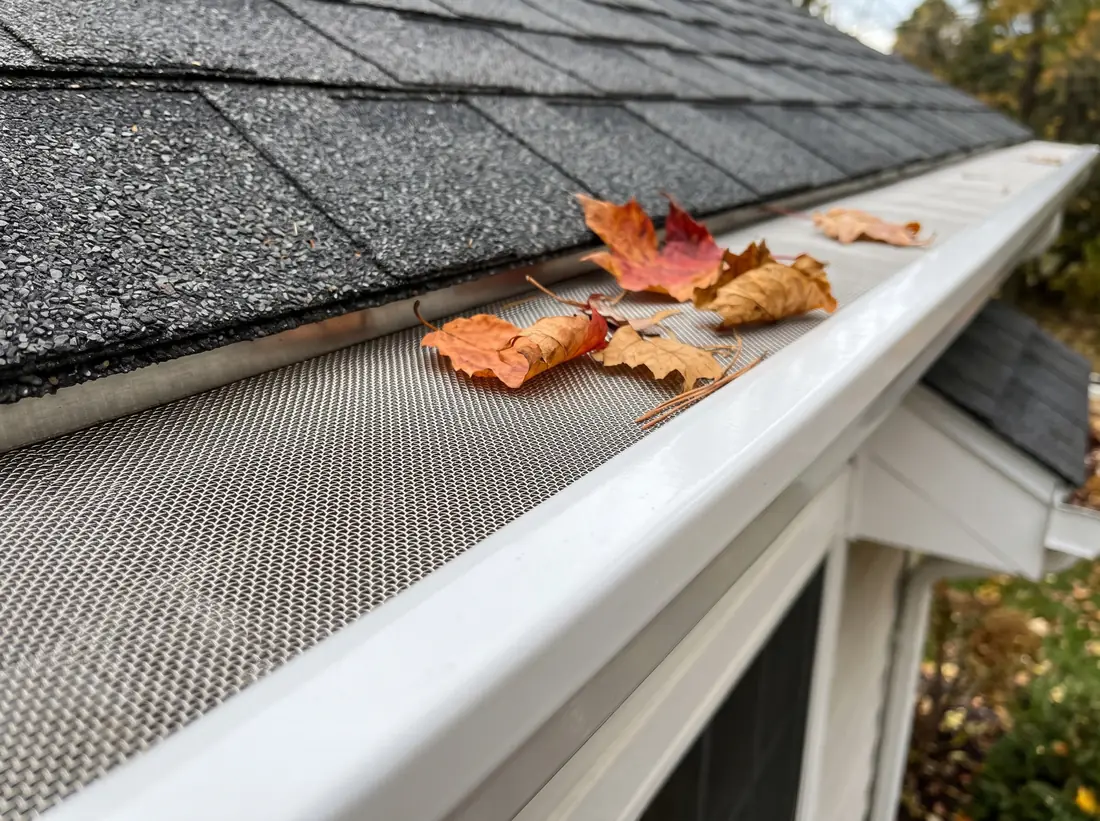
| Plastic screen | Perforated plastic sheet over the gutter | Cheap, easy to fit | Brittle in cold; small debris passes |
| Metal screen | Expanded or punched aluminum or steel | Stronger than plastic | Small seeds and catkins pass |
| Reverse-curve hood | Solid cover; water follows the curve into a slot | Sheds big leaves well | Overshoot in downpours; slot can ice up |
| Micro-mesh, for comparison | Fine stainless mesh in a frame | Stops fine debris | Higher cost; needs brushing |
How do screens cope with Fox Cities trees?
They stop large leaves, which is most of the autumn load from maples and oaks. They do not stop winged maple seeds, oak catkins or honeylocust leaflets, which pass through the openings and collect in the trough beneath, where they are harder to clean out. On houses with mostly large-leaved trees and few seeds, a well-fixed metal screen can still cut cleaning.
How do reverse-curve covers behave?
Water clings to the rounded front edge by surface tension and runs into a slot; leaves slide off the top. In moderate rain they work well. In a heavy downpour on a steep roof, some water can shoot past the slot. Fine debris can enter the slot, and the trough beneath is hard to get at for cleaning. Some systems replace the gutter entirely; others fit over existing K-style.
What happens in winter?
Plastic screens turn brittle in deep cold and crack under sliding snow or ladders. Metal screens fare better. Reverse-curve slots can fill with snow and ice, and meltwater then runs over the front. None of these types prevents ice dams, which start with heat escaping into the attic. Firm fixing matters most: a guard that lifts in wind or is dragged off by snow does more harm than good.
How do they handle heavy rain?
At Appleton's 10-year, five-minute rate of about 6.44 inches an hour, open screens pass rain readily. Reverse-curve hoods are the type most likely to shed water past the gutter in a cloudburst, especially on steep roofs.
When might a screen or cover be the right choice?
- On a low single-storey house under large-leaved trees, where a cheap metal screen cuts cleaning.
- Where a homeowner wants an inexpensive first step and is happy to clean beneath it occasionally.
- On a house where a reverse-curve system is already fitted and working.
When is micro-mesh better?
Under maples, oaks and honeylocust, where fine debris is a large part of the load, and on tall houses where cleaning beneath a screen is hard. See micro-mesh guards.
What upkeep do they need?
Screens need lifting and cleaning beneath as small debris builds up. Reverse-curve hoods need the slot cleared and the gutter beneath flushed, which usually means removing sections. Check fixings after storms and winters.
What should you check before buying?
Whether the guard is metal or plastic, how it fixes at front and back, whether it will lift shingles, whether it can be removed for cleaning, and what the maker recommends for maintenance. Clean and repair the gutters first. See are gutter guards worth it?.
What does it cost compared with mesh?
Plastic screens are the cheapest guard you can buy, metal screens a little more, and hood systems and good micro-mesh considerably more, especially when installed by a contractor. Compare quotes per foot over the same footage, and include the cost of cleaning beneath screens over the years.
Can an old cover be removed?
Yes. If a reverse-curve or screen system is not working, it can usually be taken off, the gutters cleaned and repaired, and micro-mesh fitted, or left open.
Do these types suit half-round?
Screens can be cut for some half-round gutters; most reverse-curve systems are made for K-style only.
Before you hire in Wisconsin
The state does not run a general contractor license or exam, according to Housecall Pro's state summary. The credential that matters is linked to permits: when a building permit for a one- or two-family dwelling is pulled by anyone other than the resident owner, that person needs Dwelling Contractor certification and a named Dwelling Contractor Qualifier. Plenty of gutter jobs need no permit, so find out whether yours does and who would take it out.
- Request proof of liability cover issued to the business itself, and look at the policy period.
- Have every detail on paper before work starts: profile, size and metal thickness, how the gutter is hung and how far apart the hangers sit, downspout count and size, each discharge point, and who hauls away the old system.
- Find out what the installer stands behind on labor, and what the coil maker stands behind on the metal and paint.
- Where a buried line or any digging is part of the plan, the contractor should file a Diggers Hotline request first; ask for the ticket number.
To have guard options priced, call (920) 280-3923.