
On this page
- How does micro-mesh work?
- Why does it suit Fox Cities trees?
- How does it handle heavy rain?
- What about snow and ice?
- How is it installed?
- What upkeep is left?
- Who should skip it?
- Does it work on low-pitch roofs?
- What should a quote show?
- Does the brand matter?
- Will it change how the gutter looks?
- Is it worth the money?
How does micro-mesh work?
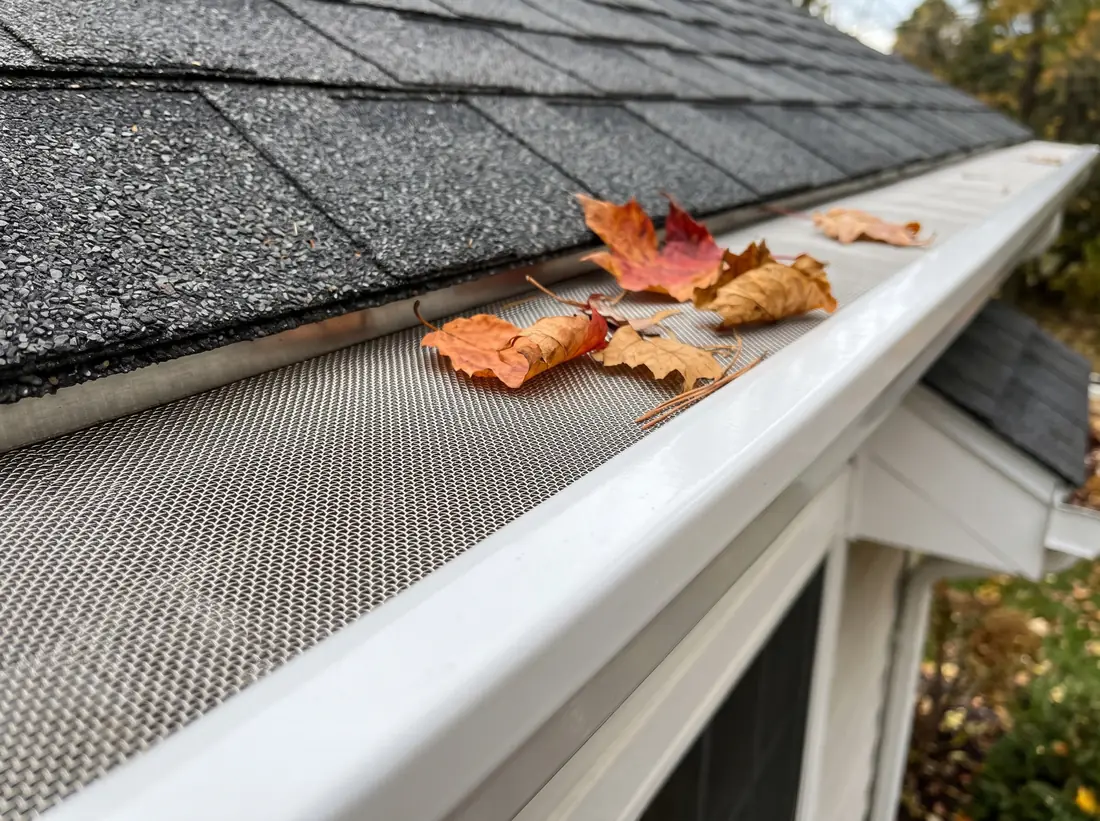
The frame, normally aluminum, spans the top of the gutter and carries a stainless mesh with openings far smaller than a seed. Rain passes through the tiny openings into the trough; leaves, seeds and twigs stay on top and blow or wash off. Better systems are screwed along the gutter's front edge and secured at the back, either on the drip edge or slipped beneath the lowest row of shingles.
Why does it suit Fox Cities trees?
Because local debris is a mix of large and very small. Maples drop winged seeds and broad leaves, oaks drop catkins and tough leaves, and honeylocust drops tiny leaflets that slip through coarse screens. Wisconsin's urban forest inventory lists Norway maple, boxelder, honeylocust and white oak among the most common large trees in Milwaukee and Madison, and maples and oaks are familiar over Fox Cities roofs too. Micro-mesh stops almost all of it.
How does it handle heavy rain?
Clean mesh passes a great deal of water. At Appleton's 10-year, five-minute rain rate of about 6.44 inches an hour, clean micro-mesh on a properly sized gutter copes well. A film of pollen, grit and fine debris slows it, and some water may then run over the front edge. A brush once or twice a year keeps it working.
What about snow and ice?
Snow rests on the mesh and melts through in a thaw. In a hard freeze ice can form on the surface, clearing as temperatures rise. Mesh has no effect on ice dams; those come from attic heat. The real winter test is fixing: a guard screwed to the front lip and secured at the back resists sliding snow, while loose snap-in types can be dragged off.
How is it installed?
- The gutters are cleaned and the downspouts flushed.
- Leaking joints are resealed and sags rehung.
- The guard is cut to length and fitted along each run.
- The front edge is screwed to the gutter lip; the back is fixed to the drip edge or tucked under shingles, depending on the system.
- Corners and ends are trimmed and closed.
- The system is tested with water.
What upkeep is left?
| Task | When |
|---|---|
| Brush the top of the mesh | Once or twice a year, and after the spring seed drop |
| Look over after storms | After big wind events |
| Check fixings | After heavy winters |
| Flush downspouts | Yearly |
Who should skip it?
Owners of a ranch in open ground, where one clean a year is cheap and quick. Owners whose gutters are leaking, sagging or too small, who will get more for the money by fixing those. And anyone whose roofing warranty prohibits disturbing the shingles, unless they choose a system that attaches only at the drip edge and gutter lip.
Does it work on low-pitch roofs?
Yes, though debris is less likely to slide off on its own, so expect to brush a little more often.
What should a quote show?
| Item | What to look for |
|---|---|
| Mesh | Stainless steel |
| Frame | Rigid, screwed to the gutter lip |
| Back edge | How it fixes; whether shingles are lifted |
| Preparation | Cleaning, resealing, rehanging included or listed |
| Corners | How they are closed |
| Price | Per foot and total footage |
| Cover | Manufacturer and installer terms in writing |
Does the brand matter?
Less than the details. Mesh fineness, whether it is stainless, how stiff the frame is and how it fixes matter more than the name on the box. Ask to see a sample piece and how the corners are closed, since corners are where cheap systems leave gaps.
Will it change how the gutter looks?
Barely. From the ground, micro-mesh sitting flat on the gutter is hard to see. Hood-style covers change the profile of the roof edge more noticeably.
Is it worth the money?
On a two-storey house under mature trees, often yes. On a low house with little canopy, often not. See are gutter guards worth it?.
Before you hire in Wisconsin
The state does not run a general contractor license or exam, according to Housecall Pro's state summary. The credential that matters is linked to permits: when a building permit for a one- or two-family dwelling is pulled by anyone other than the resident owner, that person needs Dwelling Contractor certification and a named Dwelling Contractor Qualifier. Plenty of gutter jobs need no permit, so find out whether yours does and who would take it out.
- Request proof of liability cover issued to the business itself, and look at the policy period.
- Have every detail on paper before work starts: profile, size and metal thickness, how the gutter is hung and how far apart the hangers sit, downspout count and size, each discharge point, and who hauls away the old system.
- Find out what the installer stands behind on labor, and what the coil maker stands behind on the metal and paint.
- Where a buried line or any digging is part of the plan, the contractor should file a Diggers Hotline request first; ask for the ticket number.
To get micro-mesh priced for your house, call (920) 280-3923.