
On this page
- How do you know it is time?
- How do storms change things?
- What should the new system do better?
- Will new gutters stop ice damage?
- What does it cost?
- What happens on the day?
- Where do replacements go wrong?
- What about older houses?
- Is replacing only the downspouts an option?
- What warranty questions should you ask?
- How far ahead should you book?
- How do you check the finished job?
How do you know it is time?
Any of these suggests replacement rather than another round of repairs:
- Joint after joint leaking, usual on old sectional systems once years of freeze and thaw have worn the seals.
- Spilling in every downpour while clean, meaning the system is too small or short of outlets.
- Storm damage on every elevation: bent lengths, opened seams, crushed outlets.
- Gutters pulling away along most of the house, often over soft fascia after a heavy winter.
- A roof replacement on the way, which takes the gutters down anyway.
- Rust through the coating on an old steel system.
If only one or two of these apply, and only to one stretch, start with gutter repair.
How do storms change things?
Wind, hail and falling limbs are among the most common reasons Fox Cities owners replace gutters. On July 27, 2026, an EF-3 tornado with winds estimated near 140 mph tracked from just west-northwest of Appleton through Fox Crossing and Menasha, damaging homes and trees. If you are claiming:
- Photograph every side, each downspout and any fallen limbs, with dates.
- Note any other damage from the same storm: siding, screens, roofing, fences, cars.
- Get a written, measured scope from the contractor showing size, thickness and footage.
- Let the adjuster compare like for like, and have any upgrades priced as separate lines.
Read anything that hands a contractor control of your claim carefully before signing.
What should the new system do better?
Copying the old layout repeats its faults. Use the replacement to:
- Size every run for its roof. Appleton's 10-year, five-minute rain rate is about 6.44 inches an hour; with This Old House's sizing method that gives 5-inch K-style roughly 780 square feet of 6/12 roof per run and 6-inch about 1,125.
- Add outlets where long runs or valleys overload one downspout.
- Move discharge off the basement wall, away from walks and drives that ice over, and away from the neighbor's lot.
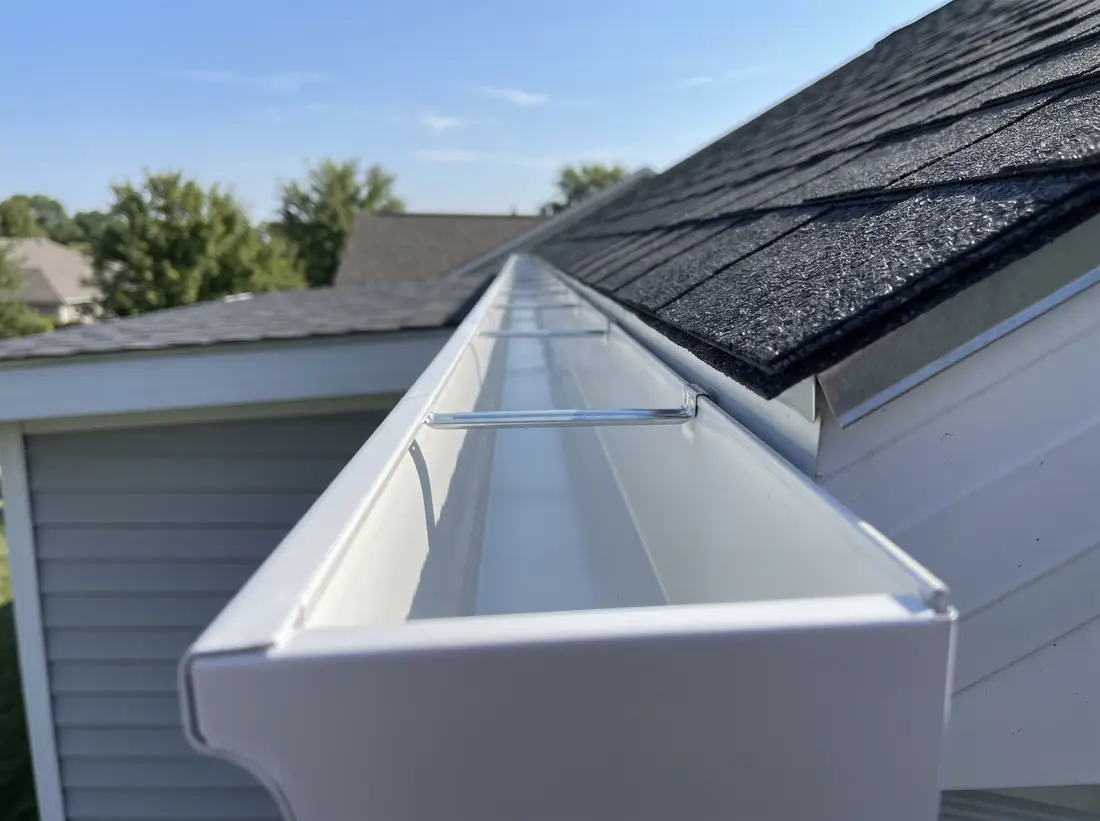
- Use hidden hangers screwed into solid wood at a spacing that carries ice.
- Repair the fascia while it is uncovered.
- Price guards if trees overhang the roof.
Will new gutters stop ice damage?
Not on their own. If ice bent or tore the old system, the cause is heat reaching the attic and melting snow on the upper roof, as University of Minnesota Extension describes. Air sealing and insulation are the lasting fix. A better gutter still helps: stronger hangers, thicker coil and a position slightly below the roof plane all cope better with whatever ice does form. See ice dams and gutters.
What does it cost?
National guides list installed 5-inch seamless aluminum at about $9 to $13 a foot and 6-inch at $12 to $18 (Angi, This Old House). Tear-off, fascia, extra downspouts and guards are added on top, and each should appear as its own line.
What happens on the day?
- The old gutters and downspouts come down, and spikes and nails are pulled.
- The fascia is checked, and soft lengths are cut out and replaced.
- New gutter is formed on site, cut to each eave and hung with its fall set.
- Corners and end caps are sealed, and downspouts and extensions fitted.
- Every run is tested with water, and scrap is cleared away.
Where do replacements go wrong?
- Same sizes as before. If the old gutters overflowed, the same size will too.
- Same downspout positions. An outlet that emptied at the basement wall should move.
- Fascia ignored. New gutters hung on soft wood fail after the next icy winter.
- Thin coil. .027-inch aluminum saves very little and bends more easily.
- No water test. Every run should be hosed before the crew leaves.
What about older houses?
Older homes near the historic centers of Appleton, Neenah and Menasha may have original trim that needs careful repair, and half-round or copper may suit them better than standard K-style. See half-round gutters.
Is replacing only the downspouts an option?
Sometimes. If the gutters are sound but the downspouts are crushed, undersized or badly placed, new 3x4-inch downspouts with proper extensions can cure overflow and protect the basement for much less.
What warranty questions should you ask?
- What does the installer's labor cover include, and for how long?
- What does the coil maker cover on metal and finish?
- Does either pass to a buyer if you sell?
- What would void it?
Get the answers in writing.
How far ahead should you book?
Late summer is ideal. Crews are busiest in spring, after ice damage shows, and after big storms. A new system put up before the leaves fall goes into winter clean and tight.
How do you check the finished job?
| Check | How |
|---|---|
| Line | From the ground, each run straight with an even fall |
| Hangers | Hidden, evenly spaced, tight to the fascia |
| Joints | Neat, sealed corners with no smears |
| Outlets | Downspouts tight to the wall, elbows sealed |
| Discharge | Extensions ending well clear of the foundation and walks |
| Test | Hose water reaches every outlet |
| Site | No offcuts, screws or tubes left behind |
Hold the final payment until every check passes.
Before you hire in Wisconsin
The state does not run a general contractor license or exam, according to Housecall Pro's state summary. The credential that matters is linked to permits: when a building permit for a one- or two-family dwelling is pulled by anyone other than the resident owner, that person needs Dwelling Contractor certification and a named Dwelling Contractor Qualifier. Plenty of gutter jobs need no permit, so find out whether yours does and who would take it out.
- Request proof of liability cover issued to the business itself, and look at the policy period.
- Have every detail on paper before work starts: profile, size and metal thickness, how the gutter is hung and how far apart the hangers sit, downspout count and size, each discharge point, and who hauls away the old system.
- Find out what the installer stands behind on labor, and what the coil maker stands behind on the metal and paint.
- Where a buried line or any digging is part of the plan, the contractor should file a Diggers Hotline request first; ask for the ticket number.
To get a replacement priced, call (920) 280-3923.