
On this page
- Which houses look right with half-round?
- How much roof can half-round drain?
- How is it hung?
- How does half-round handle snow and ice?
- Which metals are available?
- What downspouts go with half-round?
- Can half-round be formed seamless?
- Are there downsides?
- How do you decide?
- How do half-round gutters age?
- What should the quote include?
Which houses look right with half-round?
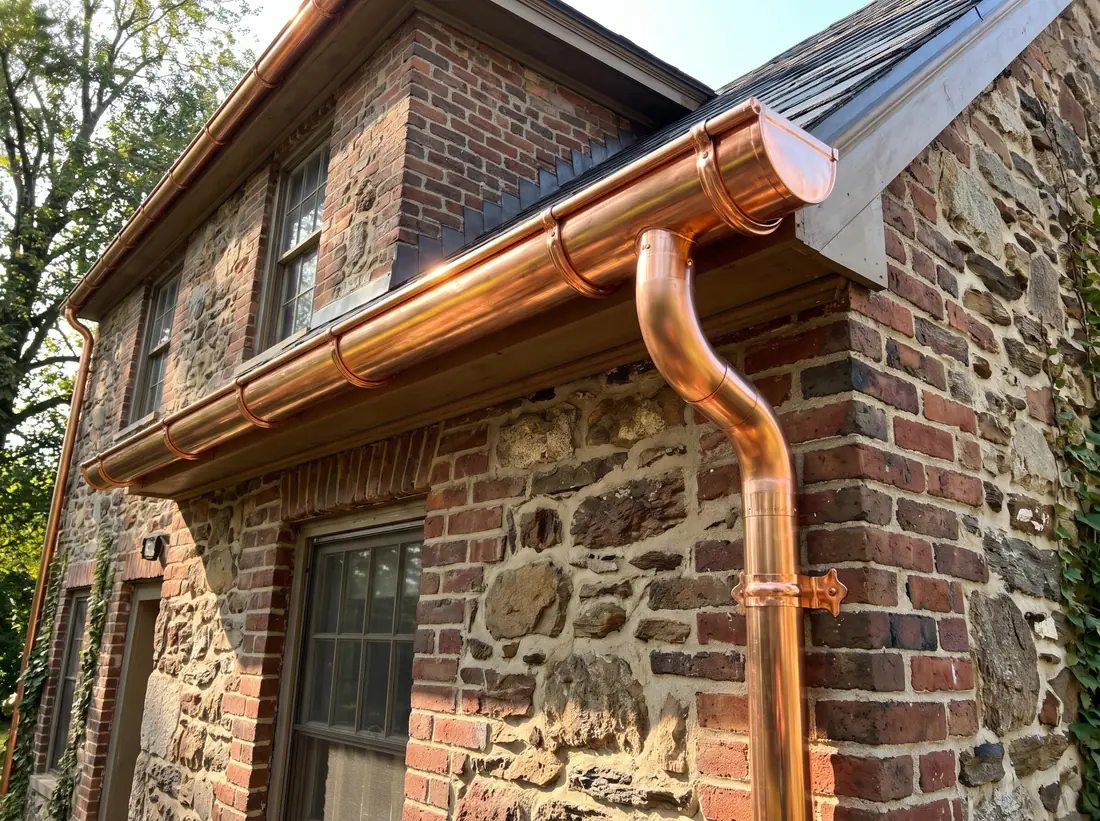
Older homes with brick, stone or detailed wooden trim, and new houses designed to look traditional. The rounded profile reads as softer and more delicate than the flat-faced K-style used on most modern houses. Many period homes in older neighborhoods across the Fox Cities were built when half-round was the norm, and putting it back can suit them better than a large modern profile.
How much roof can half-round drain?
Less than people expect. For Appleton, NOAA's Atlas 14 lists a 10-year, five-minute rain intensity of around 6.44 inches an hour. Put through the This Old House sizing approach at a 6/12 pitch, the limits per run come out at about:
| Gutter | Roof one run can take |
|---|---|
| 5-inch half-round | about 355 sq ft |
| 6-inch half-round | about 540 sq ft |
| 5-inch K-style, for comparison | about 780 sq ft |
So a roof plane that 5-inch K-style handles comfortably may need 6-inch half-round, or 5-inch with an outlet at each end. Measure each plane flat, eave length times level depth to the ridge, and size accordingly.
How is it hung?
Half-round sits in brackets rather than on the hidden hangers used for K-style. Brackets can fix to the face of the fascia, or as straps to the roof deck under the shingles on houses with no fascia. Either way, they need to be close together and screwed into sound wood, because a half-round trough full of ice is heavy and the rounded shape gives it less stiffness than a K-style section.
How does half-round handle snow and ice?
Its open shape is easy to clean, and ice tends to sit in a smooth curve rather than packing into corners. On the other hand, the front edge is lower relative to the roof, so sliding snow is more likely to catch it. Close bracket spacing, a gutter set well under the drip edge and, on steep roofs above doors, snow guards help. Ice dams themselves come from attic heat, as University of Minnesota Extension explains.
Which metals are available?
| Metal | Character | Price guide |
|---|---|---|
| Copper | Classic; soldered joints; weathers to brown and green | About $25 to $40 a foot installed |
| Aluminum | Light; painted finishes; lower cost | Toward the K-style aluminum range |
| Galvalume or galvanized steel | Stiff; plain finish | Varies |
Copper prices are national ranges from Angi and This Old House. See copper gutters.
What downspouts go with half-round?
Round ones, usually 3- or 4-inch, joined to the gutter with a round drop outlet. Because half-round carries less, it benefits from more outlets placed closer together. Discharge still needs to be at least four feet from the foundation and away from walks. See downspouts.
Can half-round be formed seamless?
Some crews can form it on site, though it is less common than seamless K-style. Many half-round systems arrive in lengths joined with soldered or sealed seams. Ask which you are getting, because joints are where freeze and thaw do their damage.
Are there downsides?
- Capacity. It needs to be larger or to have more outlets than K-style.
- Cost. Brackets, round outlets and fewer installers push the price up.
- Guards. The choice is narrower.
- Repair. Matching an old half-round system can be hard if the profile is no longer made.
How do you decide?
If the house is older or traditional and the roof planes are modest, half-round is a fine choice, particularly in copper. On a large modern roof, K-style usually drains better for less money. A contractor can show both sizes against your actual roof areas.
How do half-round gutters age?
Copper half-round can last for decades; its soldered seams are the strong point and its brackets the weak one, especially where they are fixed through to the roof deck. Aluminum half-round ages much like K-style aluminum, with the joints and finish the parts to watch. On any half-round system, check the brackets after a heavy winter, because a single loose bracket lets the trough twist and spill.
What should the quote include?
Size and metal, bracket type and spacing, how many round downspouts and where they go, how joints are made, and whether any fascia or roof-edge work is needed first.
Before you hire in Wisconsin
The state does not run a general contractor license or exam, according to Housecall Pro's state summary. The credential that matters is linked to permits: when a building permit for a one- or two-family dwelling is pulled by anyone other than the resident owner, that person needs Dwelling Contractor certification and a named Dwelling Contractor Qualifier. Plenty of gutter jobs need no permit, so find out whether yours does and who would take it out.
- Request proof of liability cover issued to the business itself, and look at the policy period.
- Have every detail on paper before work starts: profile, size and metal thickness, how the gutter is hung and how far apart the hangers sit, downspout count and size, each discharge point, and who hauls away the old system.
- Find out what the installer stands behind on labor, and what the coil maker stands behind on the metal and paint.
- Where a buried line or any digging is part of the plan, the contractor should file a Diggers Hotline request first; ask for the ticket number.
To get half-round gutters measured and priced, call (920) 280-3923.