
On this page
- What does a downspout actually have to do?
- Which size is right?
- How many does a run need?
- Where should the water end up?
- What about buried lines?
- How do you stop downspouts freezing?
- How should downspouts be fixed to the wall?
- Should downspouts be added to an existing system?
- How can you test the layout?
- What does the quote need to say?
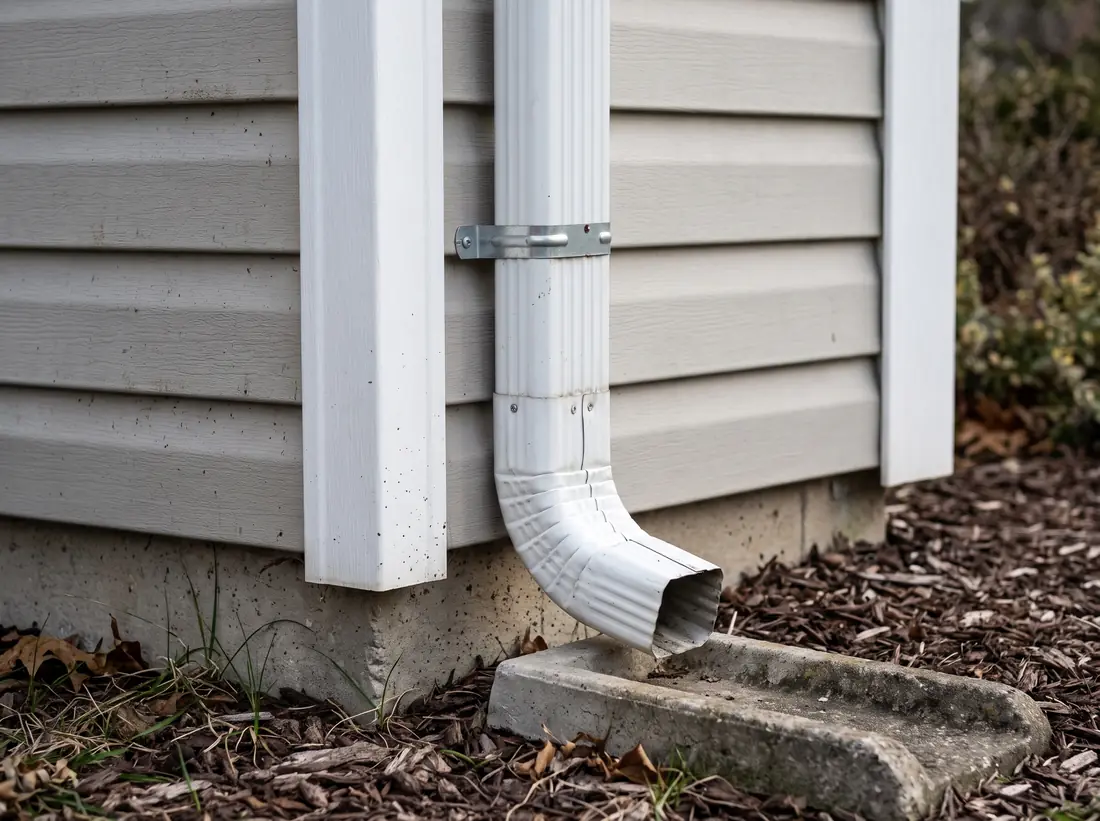
What does a downspout actually have to do?
Two things: take water out of the gutter as fast as it arrives, and put it somewhere harmless. Most overflow problems are really outlet problems, and most wet-basement problems start where a downspout ends.
Which size is right?
| Downspout | Relative flow | Where it fits |
|---|---|---|
| 2x3-inch rectangular | Base | Short runs, small roofs, sheds and porches |
| 3x4-inch rectangular | Roughly double | Most two-storey runs, 6-inch gutter, under trees |
| 3-inch or 4-inch round | Varies by size | Half-round systems |
| 4x5-inch and larger | Commercial | Big commercial roofs |
Bigger downspouts also have wider elbows, which matters in the Fox Cities: maple seeds, catkins and twigs lodge in narrow elbows, and in winter a lodged plug becomes ice.
How many does a run need?
Work back from the roof. At Appleton's 10-year, five-minute storm rate of roughly 6.44 inches an hour, This Old House's sizing method puts the limit for a 5-inch K-style run at about 780 square feet of 6/12 roof. A long run can stay within that by having an outlet at each end and falling both ways. As a rule of thumb, allow one downspout per 30 to 40 feet of gutter, plus one near the bottom of any large valley, then check the roof areas.
Where should the water end up?
| Option | Distance | Things to know |
|---|---|---|
| Splash block | 1 to 2 feet | Often not far enough beside a basement |
| Extension | 4 to 10 feet | Hinged types lift for mowing and snow clearing |
| Buried solid pipe to an emitter | 10 feet and more | Needs steady fall; keep the outlet out of hollows |
| Storm sewer | To the street | Only where your community allows |
| Rain barrel | Stored | Summer use; empty and disconnect before winter |
Never point discharge across a sidewalk or drive in winter, and keep it on your own lot. See downspouts and wet basements.
What about buried lines?
They tidy up a yard and carry water much further, but they need doing properly:
- Solid pipe, not perforated, so the water does not leak back into the soil by the house.
- Steady fall from top to bottom, so nothing sits and freezes.
- A cleanout fitting near the downspout.
- An outlet that daylights on your own lot.
- A Diggers Hotline request three working days before any trench is dug. The law covers homeowners too.
Local rules also apply. Kaukauna's code keeps roof water out of the sanitary sewer and bars downspouts from ponding water on a neighbor's lot. See Appleton stormwater and downspouts.
How do you stop downspouts freezing?
- Use 3x4-inch sections, which take longer to fill with ice.
- Keep elbows clean so debris does not give ice a start.
- Use extensions that lift or swing clear of plowed snow.
- Avoid long flat runs of extension where water can sit.
- Fix the attic if heavy ice is forming; constant meltwater feeds frozen outlets.
How should downspouts be fixed to the wall?
With straps at the top, the middle and near the bottom, screwed into solid backing. Loose straps let the downspout rattle and twist, and the joint at the gutter outlet opens. On a busy side of the house, a strap close to the ground stops mowers and shovels knocking it out of line.
Should downspouts be added to an existing system?
Often that is the cheapest cure for overflow. A new outlet in the middle of a long run halves the roof each section drains. Cutting in an outlet and adding a downspout is a small job compared with new gutters.
How can you test the layout?
Run a hose at the far end of each gutter and watch where the water comes out. Then walk the yard after the next storm and the next thaw. Look for puddles near the house, washed-out beds, ice on walks and water heading for the neighbor, and move extensions while the fix is still small.
What does the quote need to say?
The size and number of downspouts, where each one goes, the elbows and extensions, any buried line with its outlet, and who requests the Diggers Hotline locate.
Before you hire in Wisconsin
The state does not run a general contractor license or exam, according to Housecall Pro's state summary. The credential that matters is linked to permits: when a building permit for a one- or two-family dwelling is pulled by anyone other than the resident owner, that person needs Dwelling Contractor certification and a named Dwelling Contractor Qualifier. Plenty of gutter jobs need no permit, so find out whether yours does and who would take it out.
- Request proof of liability cover issued to the business itself, and look at the policy period.
- Have every detail on paper before work starts: profile, size and metal thickness, how the gutter is hung and how far apart the hangers sit, downspout count and size, each discharge point, and who hauls away the old system.
- Find out what the installer stands behind on labor, and what the coil maker stands behind on the metal and paint.
- Where a buried line or any digging is part of the plan, the contractor should file a Diggers Hotline request first; ask for the ticket number.
To have the downspouts on your house planned or added, call (920) 280-3923.