
On this page
- What actually decides it?
- Which guard types hold up here?
- Who usually comes out ahead?
- Who usually does not?
- How does Fox Cities weather treat guards?
- How do you do the sums?
- What should happen before guards go on?
- What maintenance is left afterwards?
- What do the different Fox Valley trees throw at a guard?
- Are guards worth it on a house you might sell?
- Should guards cover the whole house?
- Which sales lines deserve a question?
What actually decides it?
Four things about your house:
- What lands on the roof. Mature maples and oaks drop far more than open sky. Appleton has also been taking out ash since emerald ash borer was found in the city in 2015, and declining ash shed twigs and bark.
- How hard the gutters are to reach. Two-storey eaves and steep pitches make every clean slower and riskier.
- How many cleans you need. Two, three or four visits a year soon add up.
- What overflow is costing you. Water spilling against a basement wall has a price, even if it never shows on an invoice.
Which guard types hold up here?
| Type | Under Fox Valley trees | In a downpour | Through snow and ice |
|---|---|---|---|
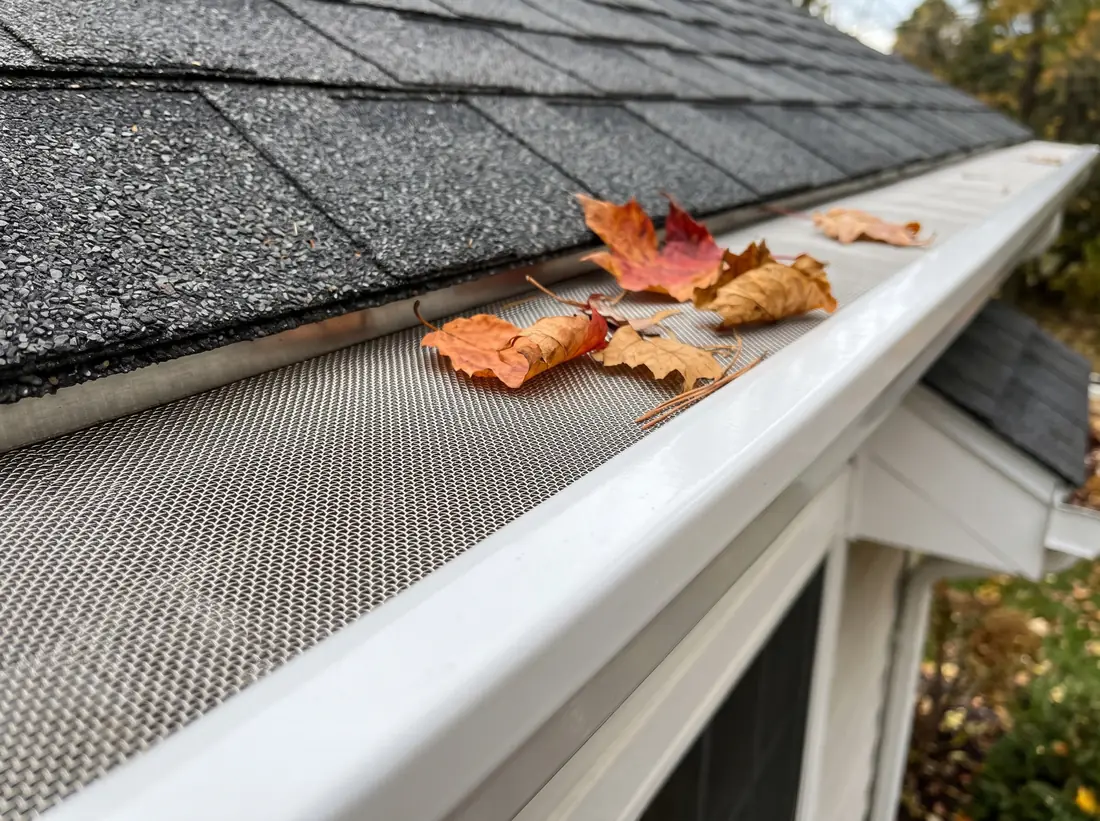
| Micro-mesh | Keeps out most seeds and fragments | Good while kept clear | Good if screwed down |
| Metal screen | Stops large leaves | Good | Fair |
| Plastic screen | Stops large leaves | Good | Poor; cracks in cold |
| Reverse-curve hood | Sheds large leaves | May overshoot | Slot can freeze |
| Foam or brush insert | Works briefly | Poor | Poor; holds water that freezes |
Who usually comes out ahead?
- Owners of two-storey houses under big trees.
- Anyone booking three or more cleans a year.
- Owners whose roofs are too high or steep to reach safely themselves.
- Houses where gutters fill and spill between cleans.
Who usually does not?
- Single-storey houses with little canopy overhead.
- Houses whose gutters are leaking, sagging or undersized. Fix those first.
- Roofs where the main debris is fine grit, which passes through any guard.
How does Fox Cities weather treat guards?
Downpours. Appleton's 10-year, five-minute rain rate is roughly 6.44 inches an hour. Clean micro-mesh passes that; mesh coated with fine debris can shed some water over the front edge. On steep roofs, reverse-curve hoods can throw water past the gutter.
Snow. Snow sits on top of any guard and melts through mesh into the trough during a thaw. Guards do nothing about ice dams, which form when attic heat warms the upper roof. What does matter is that the guard is screwed firmly in place, so sliding snow cannot peel it off.
Deep cold. Plastic guards go brittle and crack. Metal holds up much better.
How do you do the sums?
Use your own numbers:
- Count the cleans you need a year now.
- Multiply by what each clean costs.
- Add what overflow is costing: fascia repairs, stained siding, a damp basement wall.
- Compare with the installed price of a good micro-mesh guard across your footage.
- Work out how many years until they break even.
A worked example: call one clean C. At three cleans a year, five years costs 15C. With guards you might still book one maintenance visit a year, so five years costs the guard price G plus 5C. The guards win over five years if G is less than 10C.
What should happen before guards go on?
Clean the gutters, reseal joints, rehang any sags, upsize outlets that overflow and replace soft fascia. A guard belongs on a system that already drains properly; on a poor one it only hides the problems.
What maintenance is left afterwards?
Brushing mesh once or twice a year, more after the spring seed drop; a look after big storms and after winter; flushing downspouts. More in how often to clean gutters.
What do the different Fox Valley trees throw at a guard?
Each species tests a guard differently. Maples drop winged seeds in late spring and a heavy leaf fall in October, and the seeds lodge in screens. Oaks drop catkins in spring, then tough leaves that can hang on into winter and come down in bursts. Pines and spruce shed needles all year, and needles slip through coarse screens and sit on mesh. Where honeylocust grows, its tiny leaflets pass through anything but fine mesh. Stainless micro-mesh is the type that copes with the widest mix, which is why it is the usual recommendation under mixed canopy. More on each species in maple, oak and ash debris.
Are guards worth it on a house you might sell?
That depends on how long you will stay. Guards rarely add much to a sale price, but gutters that are clean and draining away from the foundation look good to buyers and inspectors. If you expect to sell within a year or two, a professional clean and any needed repairs is usually the better spend. If you plan to stay for five years or more under heavy trees, guards make more sense.
Should guards cover the whole house?
Not always. Many owners fit guards only on the runs under the trees and leave open sun-facing runs bare, cleaning those once a year. It cuts the cost, and the back of the house under the biggest trees is usually where guards pay for themselves first.
Which sales lines deserve a question?
| What you hear | What to ask |
|---|---|
| "You'll never clean gutters again" | What maintenance does the maker recommend? |
| "Handles any storm" | Tested at what rainfall rate and roof pitch? |
| "Prevents ice dams" | Ice dams start in the attic. How would a guard stop one? |
| "Lifetime warranty" | Covering what, and does it pass to a buyer? |
| "Price good today only" | Can I have the quote in writing to compare? |
To get guards priced against the cost of cleaning on your house, call (920) 280-3923.